.png?width=300&height=103&name=Ads%C4%B1z%20tasar%C4%B1m%20(6).png "Adsız tasarım (6)")

What Is the Circuit Breaker Pattern—and Why Is It Critical for Modern Microservices?
In today’s world of distributed systems, microservices constantly communicate with each other. This approach gives us flexibility and scalability, but it also introduces a common problem: when one service starts to fail, those failures can easily spread and impact the entire system.
The Circuit Breaker is designed to stop this chain reaction. Instead of repeatedly calling a service that’s already having trouble, it temporarily stops incoming requests and gives the system a chance to recover.
Think of it as a simple safety net that helps your application stay responsive even when things go wrong.
In this article, we’ll walk through the Circuit Breaker Pattern from a developer’s point of view—how it works, why it’s useful, and when you should consider using it in your microservice-based applications.
What Is the Circuit Breaker Pattern?
The Circuit Breaker, as the name suggests, is a resilience pattern that helps manage service-to-service calls in a safe and controlled way. Its main goal is to prevent failures in one service from negatively affecting others.
Let’s explain this with a real-life example from an e-commerce payment system. In modern software architectures, services are highly interconnected—payment services, product inventory services, shipping services, bank APIs, and more.
If one of these services goes down, its impact can grow like a line of dominoes and eventually paralyze the entire system. This is exactly where the Circuit Breaker Pattern steps in.
Just like an electrical fuse in real life, a circuit breaker in software does the same thing: it cuts off the problem before it grows bigger.
Why Do We Need a Circuit Breaker?
Imagine you’re on an e-commerce website trying to complete a payment. The payment is processed through a bank’s API.
During a campaign period, the bank API becomes overloaded—it may take 20–30 seconds to respond, sometimes not respond at all, or even completely go down.
If a single payment request takes 25 seconds, this quickly becomes a disaster for a large e-commerce platform handling thousands of payments per second.
- The payment cannot be completed
- The user abandons the order
- Revenue is lost
Worse still, the payment service continues sending requests to the failing bank API, exhausting its thread pool and eventually making the entire system unresponsive.
This is where the Circuit Breaker becomes a true lifesaver.
How Does the Circuit Breaker Work?
A Circuit Breaker has three main states:
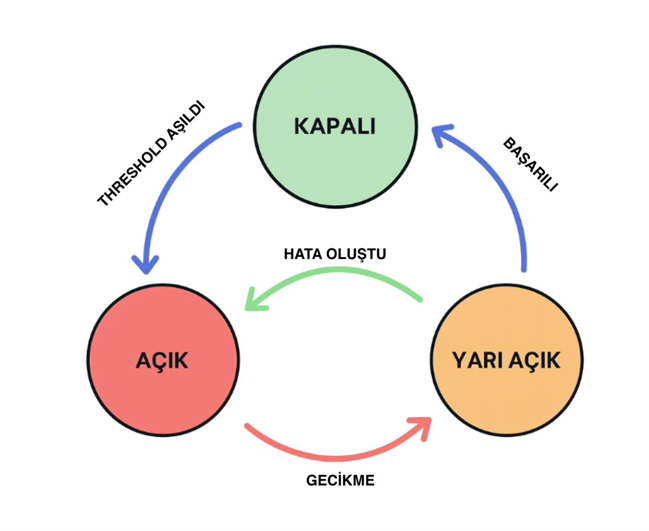
Closed (Normal State)
The system operates normally, and all requests are sent to the bank API. Errors and timeouts are continuously monitored.
For example, if 10 out of the last 20 requests fail, the failure rate reaches 50%, and the circuit transitions to the Open state.
Open (Failure State)
In this state, no requests are sent to the bank API.
- To avoid stressing an already failing service
- To prevent thread pool exhaustion
- To keep the overall system responsive
At this point, fallback logic is triggered. The user receives a message such as:
“Your bank is currently not responding. Your payment could not be completed, but your order has been placed in Pending status. We will retry the payment shortly.”
Thanks to this approach:
- The user does not lose items in the cart
- Cart abandonment rates decrease
- Revenue loss is prevented
- Product reservations remain intact
- The website stays online
Half-Open (Recovery Check)
After a predefined wait time (for example, 10 seconds), the Circuit Breaker sends a small number of test requests to check if the bank API has recovered.
- If successful → transition back to Closed
- If failed → switch back to Open
This allows the system to recover automatically without manual intervention.
Summary: Circuit Breaker in an E-Commerce Payment Flow
- The user clicks the “Pay” button
- The Payment Service sends a request to the bank API
- The third-party API goes down
- The Circuit Breaker switches to the Open state
- Fallback logic runs and the order is marked as “Pending Payment”
- The bank recovers and a retry mechanism runs
- The payment is completed and the status becomes “Paid”
The user never sees an error screen.
Conclusion
The Circuit Breaker Pattern is one of the most critical safety mechanisms in modern microservice architectures.
It is especially important for:
- E-commerce platforms
- Fintech applications
- Subscription-based services
- Any system heavily dependent on third-party APIs
Circuit Breaker = better user experience + protected revenue + a resilient system
References
- Martin Fowler – Circuit Breaker
- Circuit Breaker Pattern Nedir? (Gökhan A.)
- Circuit Breaker Pattern Nedir? (Gürcan Özdecan)
This article has been written by Halime Öztürk